
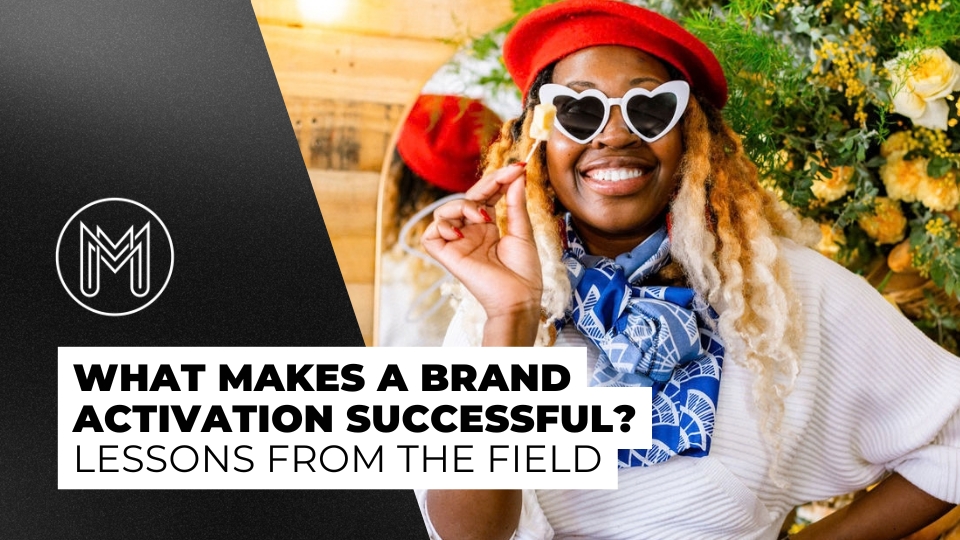
The best brand activations often look effortless. Behind the scenes, they rarely are.
A successful brand activation is the result of hundreds of decisions – from the strategy and creative idea to the environment, consumer journey, team on the ground and how success will ultimately be measured.
As an experiential marketing and brand activation agency in South Africa, Matriarch has spent years creating and delivering brand experiences across different audiences, environments and industries.
Here are some of the lessons we’ve learnt from the field.
1. Design for behaviour, not just demographics
Knowing your target audience is only the starting point.
The more useful question is: what behaviour are we trying to influence, and what is happening around the consumer when we’re trying to influence it?
Someone moving through a high-footfall retail environment behaves very differently from someone spending an afternoon at a festival. One audience may give you 30 seconds; another may happily spend ten minutes exploring.
Understanding that context should influence everything from the scale and placement of the activation to the messaging, mechanic and expected dwell time.
It also means identifying potential barriers. What might stop someone approaching? Does the experience immediately make sense? Are we asking too much before we’ve given them something of value?

2. Make the experience worth participating in
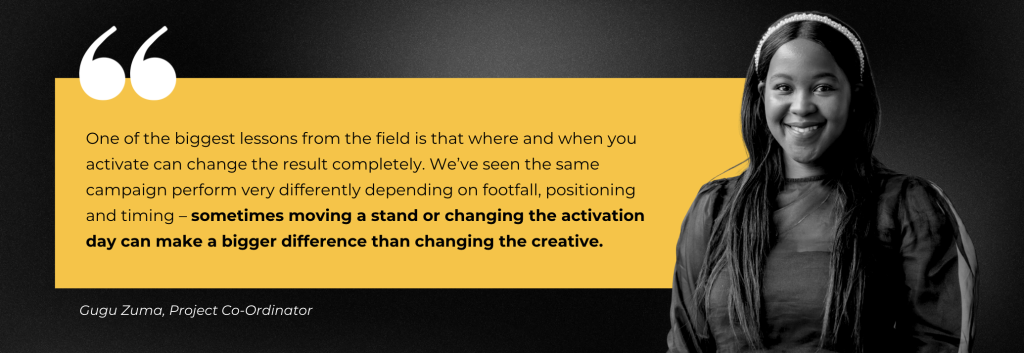
Prizes, samples and giveaways can be powerful drivers of participation – but they shouldn’t have to do all the work.
A useful test is: is the experience itself worth participating in, or is the incentive carrying it?
The strongest brand activations give consumers something meaningful in exchange for their attention – whether that’s entertainment, discovery, personalisation, utility, access or simply a memorable moment.
And the interaction should always connect back to the brand.
High participation doesn’t necessarily equal a successful activation. If consumers remember the game but can’t remember the brand behind it, the experience hasn’t worked hard enough.
3. Give people something they haven’t seen before
Consumers have seen a lot.
Photo moments, sampling stations, competitions and interactive games can all still work brilliantly – but simply putting a logo on a familiar mechanic isn’t enough to create a memorable brand experience.
Often, what creates impact is an element of surprise.
It could be an unexpected interaction, a clever reveal, personalisation, a new use of technology or a familiar mechanic approached in an entirely different way.
It doesn’t need to be expensive or complicated. Some of the strongest experiential marketing ideas are incredibly simple – they’re just unexpected, relevant and beautifully executed.
Creating that brief “I haven’t seen this before” moment builds curiosity, draws people in and gives them something worth talking about afterwards.
4. Your people are the brand
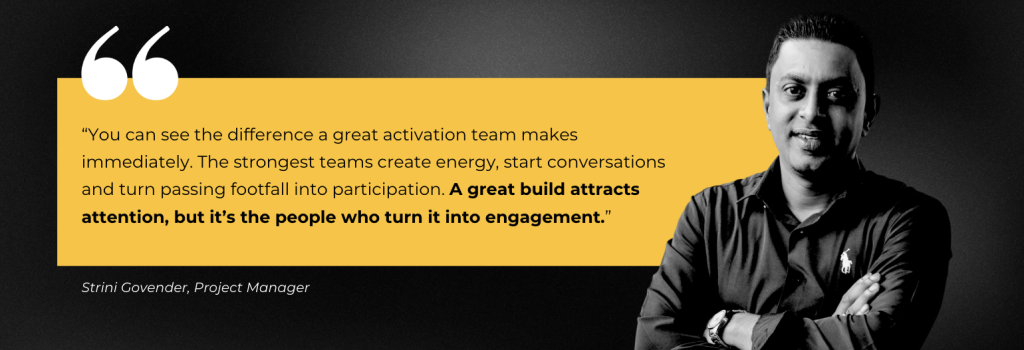
The team on the ground can make or break a brand activation.
You can have a brilliant strategy, exceptional creative and a beautifully produced build, but if the consumer interaction feels flat, awkward or scripted, the experience immediately loses impact.
Brand ambassadors aren’t simply there to facilitate the activation. They are the brand in that moment.
The best teams know how to read both the environment and the person in front of them. They know when to approach, when to step back, how to explain an experience quickly and how to turn a planned interaction into something that feels genuinely human.
That’s why recruitment, training and briefing should receive the same attention as the physical activation itself.
Product knowledge matters. Brand understanding matters. But personality, energy and the ability to connect naturally with people are equally important.
5. Design for the real world
A brand activation idea can work beautifully in a presentation and fall apart in a live environment.
This is where experience on the ground becomes invaluable.
How quickly can consumers move through the activation? What happens when 100 people arrive at once? Can someone understand what to do without a lengthy explanation? What happens when stock runs low, connectivity drops or the weather changes?
Then there are the less glamorous details: storage, replenishment, queues, staff breaks, power, signage, accessibility, venue restrictions, load-in and breakdown.
Consumers shouldn’t notice any of this.
That’s the point.
Great execution removes friction, allowing the consumer to experience something that feels intuitive and effortless.

6. Create something worth sharing
“Instagrammable” isn’t a strategy.
If social amplification is an objective, it needs to be considered from the beginning rather than solved with a branded photo wall at the end.
Ask instead: what will happen here that someone will genuinely want to capture?
It might be a transformation, reveal, reaction, challenge, personalised result or completely unexpected moment.
The strongest social content is often a natural by-product of a genuinely good brand experience.
7. Measure what actually matters
High footfall can look impressive in a post-campaign report. But numbers only mean something when they’re connected to the original objective.
If the objective was product trial, measure trial. If it was education, look at meaningful engagement. If it was lead generation, measure qualified leads. If it’s purchase, build sales or redemption tracking into the experience wherever possible.
Depending on the campaign, brand activation metrics might include participation, dwell time, samples distributed, leads captured, sales, redemptions, content created, social engagement or consumer feedback.
Most importantly, define what success looks like before the activation goes live.
That way, the experience can be designed to deliver against the objective – rather than finding a metric afterwards that makes the results look good.

The difference is in the detail
There is no single formula for a successful brand activation.
Different audiences, environments and objectives demand different solutions. But the strongest brand activations in South Africa tend to share the same foundations: a clear strategic purpose, an idea worth engaging with, something unexpected, exceptional people on the ground, rigorous execution and a clear definition of success.
Because consumers don’t see the strategy decks, production schedules or operational planning behind an activation.
They simply know whether the experience was worth stopping for.