When it comes to brand activations, location isn’t simply a logistical decision. It’s part of the strategy.
A high-footfall space might put your brand in front of thousands of people, but that doesn’t automatically make it the right place to activate.
The better question is: where will your audience be most open to stopping, participating and engaging with your brand?
From malls and retail stores to festivals, campuses, workplaces and community spaces, different environments create very different opportunities.
After years of delivering activations across South Africa, here’s what we’ve learnt about choosing the right place – and the right moment – to show up.

1. Malls: footfall is only the starting point
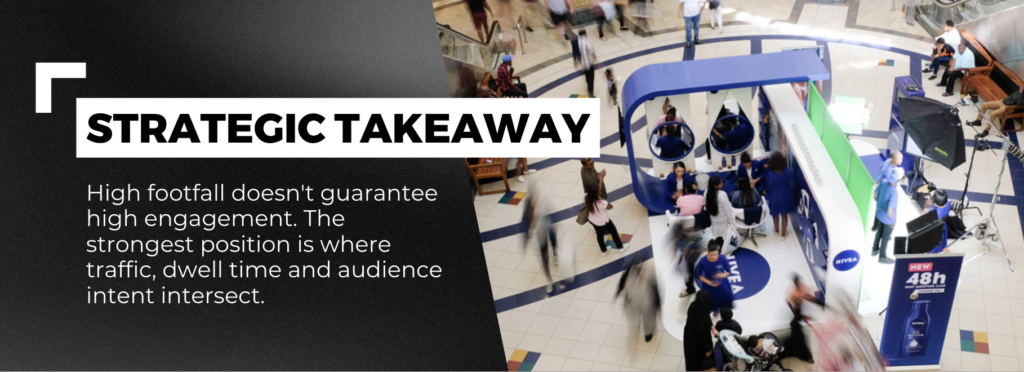
Malls offer scale, strong footfall and access to consumers already in a discovery and spending mindset.
But choosing the right mall is only part of the equation. Where and how you position the activation can have a significant impact on performance.
Entrances, food courts, anchor retailers and natural pathways create very different patterns of movement. And importantly, the busiest position isn’t always the best one. High traffic means little if people are rushing past, the stand is difficult to access or the audience isn’t relevant.
We’ve seen this first-hand. In our national activation work, strategic positioning near natural high-traffic areas increased visibility and engagement, while quieter locations required the activation to work considerably harder.
The aim isn’t simply to find the highest number of people. It’s to identify where the right audience naturally slows down, becomes receptive and has an opportunity to engage.
2. Retail & in-store: understand the shopping mission
In-store activations have one major advantage: proximity to purchase.
That makes retail particularly powerful for sampling, product demonstrations, education, trial and conversion.
But retail isn’t one environment.
Modern trade offers scale, structured shopper journeys and opportunities to connect trial directly to purchase.
Wholesale brings different basket sizes, shopping missions and often more commercially focused consumers.
Within informal trade, space, local relationships, shopper behaviour and the role of the retailer can all influence how a brand should show up.
The experience needs to respond accordingly.
A shopper doing a quick grocery run shouldn’t need five minutes to understand the mechanic. Equally, when trial is the objective, removing friction between experience → product → purchase can make the activation work much harder.
STRATEGIC TAKEAWAY:
The closer you are to purchase, the less friction there should be between engagement and action.
3. Festivals & events: earn your place in the experience
Festivals and live events give brands something many environments can’t: time, energy and an audience already looking for experiences.
That creates opportunities to go deeper – through entertainment, challenges, personalisation, content and unexpected moments.
But brands are also competing harder for attention.
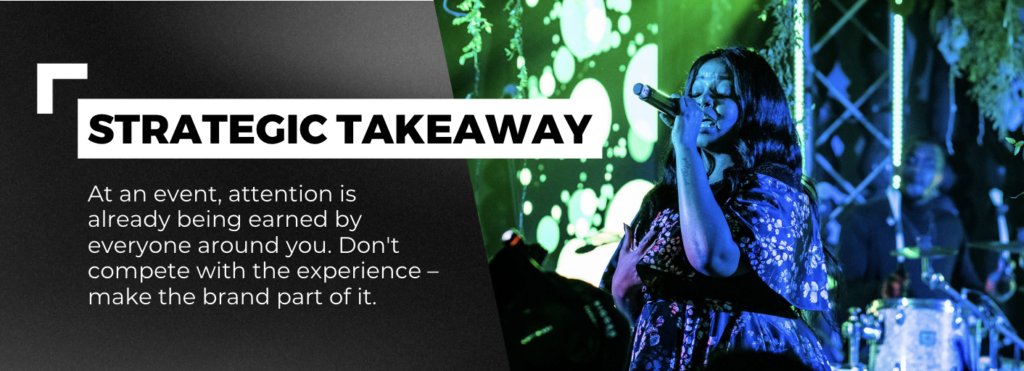
At a busy event, another branded stand isn’t enough. The activation needs to contribute something to the occasion: entertainment, utility, access, comfort, surprise or a genuinely memorable interaction.
The strongest event activations don’t feel like advertising sitting alongside the experience. They feel like part of the reason the experience was memorable.
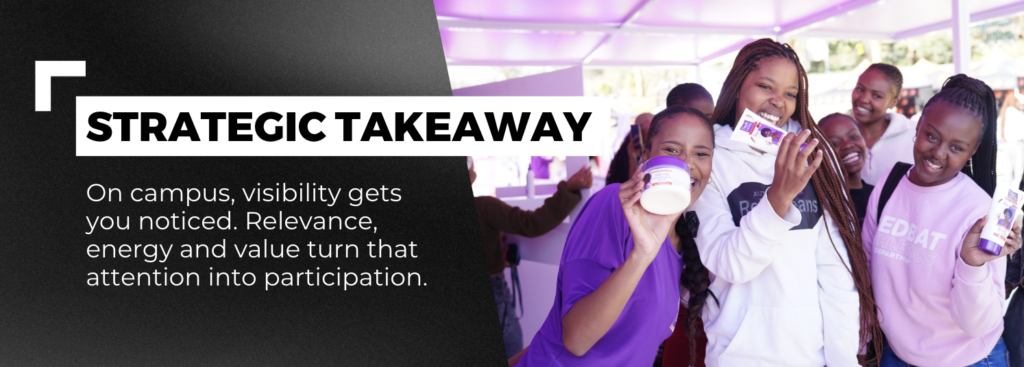
4. Campuses: relevance beats presence
Campus activations have their own rhythm.
Students move between lectures, residences, registration areas and social spaces – often with limited time and plenty of brands competing for their attention.
Location can therefore change everything.
Our experience has shown that positioning within natural student movement – entrances, registration areas, residences and busy thoroughfares – can significantly improve participation.
But visibility alone isn’t enough.
Students need a reason to stop. The strongest campus experiences offer something useful, social, entertaining or rewarding, with a journey that’s immediately understood and easy to complete.
Peer behaviour matters too. An activation that looks active and engaging from a distance naturally creates curiosity and social proof.
5. Community spaces: local relevance matters
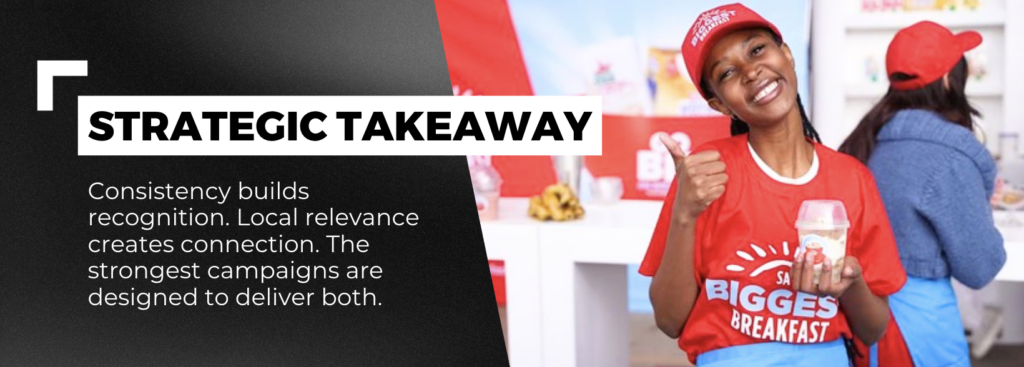
Community activations take brands closer to where people actually live, shop and spend their time.
But this is where a one-size-fits-all approach can quickly fall short.
Language, location, messaging, rewards and the team on the ground can all influence how naturally people engage.
Our national experience has shown that shifting activity into malls, office parks and community environments can sometimes unlock stronger engagement than relying on more traditional locations alone.
The goal isn’t to reinvent the campaign in every location. It’s to create a strong central idea with enough flexibility to respond to the local audience and environment.
6. Workplaces: convenience can be the value
Sometimes the strongest activation opportunity is simply where your audience already is.
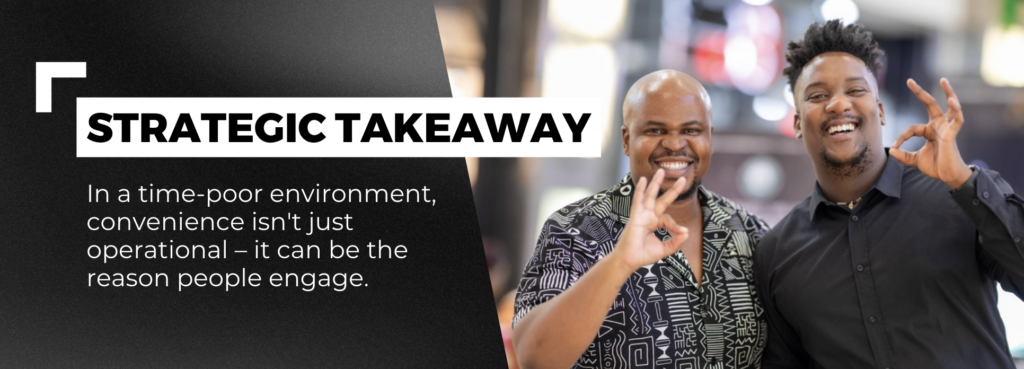
Workplace and office activations can remove a significant barrier by taking a product, service or experience directly to people.
We’ve seen consumers respond positively to on-site assistance precisely because it saves them a separate trip elsewhere.
In this environment, convenience becomes part of the value exchange.
But you’re also entering someone’s working day. The experience needs to be quick to understand, easy to navigate and genuinely useful.
7. Timing can change everything
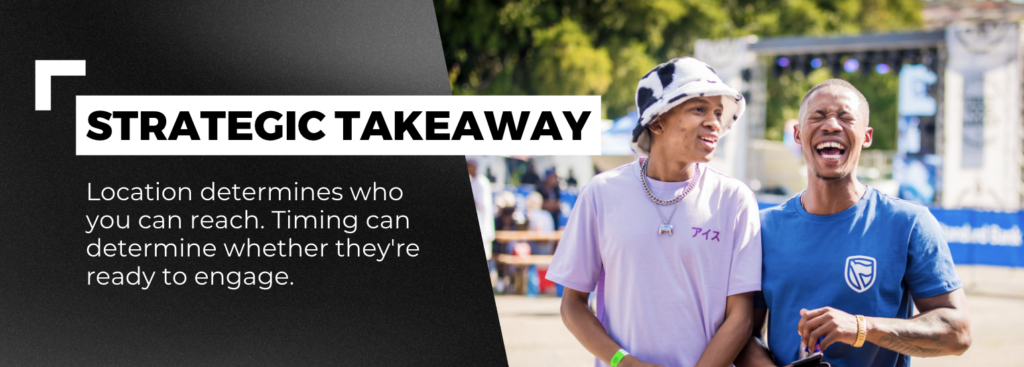
The right location is only half the equation.
When you activate can be just as important as where.
We’ve seen engagement shift depending on payday periods, weekends and consumer traffic patterns. In previous campaigns, weekend activity has outperformed midweek activations, while aligning activity with payday periods has also helped drive engagement.
So activation planning shouldn’t stop once the venue is booked.
When will your audience actually be there? Why will they be there? How much time will they have? And what will their mindset be when you approach them?
Sometimes the location isn’t wrong. The timing is.
So, where should your next brand activation be?
There isn’t one environment that works best for every brand activation.
Malls offer scale. Retail gets you closer to purchase. Festivals offer time and energy. Campuses provide access to defined communities. Workplaces offer convenience. Community spaces create opportunities for local relevance and connection.
The right choice comes back to three questions:
Who are you trying to reach?
What do you want them to do?
And where will they be most receptive to doing it?
Because the best activation location isn’t necessarily where the most people are.
It’s where the right audience, the right mindset and the right moment come together.